Need More Buyers? How to Attract Customers and Turn Attention Into Sales

If you are asking, “How can I get more buyers? ”, you are dealing with one of the most important questions in business. A company can have an impressive website, a useful product, competitive prices, and active social-media accounts, yet still struggle to produce dependable sales. The problem is rarely a complete lack of marketing activity. More often, the business is attracting the wrong people, communicating an unclear promise, losing trust somewhere along the buying journey, or failing to follow up after a prospect shows interest. Picture your marketing as a water pipe: increasing the water pressure will not solve the problem if the pipe has several leaks. You first need to find the leaks, repair them, and then increase the flow.
Modern buyers also arrive with more information and higher expectations than buyers of the past. Many research products, compare alternatives, read reviews, watch demonstrations, and consult AI tools before contacting a business. HubSpot’s current marketing data reports that nearly 70% of marketers say leads are arriving later in the purchasing process after conducting more AI-assisted research. The same research indicates that 93% of marketers believe personalization improves leads or purchases. This means your prospects may already have a shortlist before you know they exist, making your online visibility, clarity, and credibility crucial. Getting more buyers is therefore not about shouting louder. It is about becoming the most relevant, believable, and convenient choice at the moment a qualified prospect is ready to act. HubSpot marketing statistics
Why Your Business Is Not Attracting Enough Buyers

A shortage of buyers usually begins with one of five underlying problems: insufficient visibility, weak targeting, an unconvincing offer, inadequate trust, or a difficult purchasing experience. These problems can look identical when you check your bank account because every one of them ultimately produces the same result—too few sales. Their solutions, however, are completely different. A company with little qualified traffic needs better discovery channels, while a company receiving plenty of visitors but few orders needs conversion improvements. Spending more on advertising before identifying the real obstruction can be like filling a car with premium fuel when it has a flat tire. You are investing more money without fixing the condition preventing movement.
Begin by tracing the customer journey from discovery to purchase. Can prospects find you when they search for the problem you solve? Does your headline immediately tell them who you help and what outcome you deliver? Do your claims feel credible? Is your price presented in the context of value, or does it appear as an unexplained expense? Can a visitor purchase, book, subscribe, or request information without encountering confusion? Ask several people who resemble your intended customers to review your buying process and describe what they think you sell. Their answers may be uncomfortable, but confusion revealed today is revenue recovered tomorrow. The purpose is not to defend your existing marketing. It is to see the experience through a buyer’s eyes and identify the exact moment at which confidence, interest, or momentum disappears.
Determine Whether You Have a Traffic or Conversion Problem

A traffic problem means too few suitable prospects are reaching your offer. A conversion problem means people are arriving but failing to take the desired action. Look at website sessions, traffic sources, relevant keyword rankings, product-page views, inquiries, checkout starts, completed purchases, and returning customers. If only 200 qualified people see an offer each month, even a respectable 3% conversion rate produces six sales. Increasing qualified traffic to 1,000 visitors at the same conversion rate would produce approximately 30 sales. If 10,000 people visit and virtually nobody buys, however, more traffic may simply create a larger audience for an offer that is not working.
Calculate your basic conversion rate by dividing completed actions by the number of relevant visitors and multiplying the result by 100. Do this for each stage rather than looking only at final sales. A business might have a strong product-page-to-cart rate but a terrible checkout completion rate. Baymard Institute’s current research places the average documented online shopping-cart abandonment rate at 70.22%. Its large-scale usability research also estimates that major ecommerce sites could achieve an average 35.26% conversion-rate improvement through better checkout design. Although your results will vary, these findings illustrate why removing friction can sometimes be more profitable than buying additional traffic. Track the numbers by device and source as well. Mobile visitors, email subscribers, organic search users, and social-media clicks can behave very differently. Baymard Institute cart-abandonment research
Define the Buyers You Actually Want
Trying to appeal to everyone often creates marketing that persuades no one. “We help businesses grow” sounds positive, but it is too broad to make a particular buyer feel understood. “We help independent home-service companies generate qualified local appointments without depending entirely on referrals” is considerably more meaningful. It identifies a customer, a desired outcome, and a common frustration. The more precisely you understand your ideal buyer, the easier it becomes to choose keywords, write headlines, develop content, design offers, and select marketing channels. Specificity is not a cage that limits your business. It is a spotlight that helps the right people recognize themselves in your message.
Create a practical buyer profile based on evidence rather than imagination. Interview current customers and examine support questions, sales conversations, website-search terms, email replies, reviews, and lost-sale notes. Identify the buyer’s urgent problem, desired result, previous failed attempts, purchasing objections, decision criteria, preferred information sources, and words used to describe the situation. If you sell an affiliate-marketing course, for example, “people interested in online income” remains too broad. A sharper audience might be adults over 50 who want to build a beginner-friendly affiliate business but feel overwhelmed by technical tools and conflicting advice. That profile immediately suggests clearer lessons, more reassuring copy, realistic examples, and a less intimidating sales process. Your objective is not merely to collect demographic facts. It is to understand the emotional and practical conversation already taking place inside the buyer’s mind.
Match Your Marketing to Buyer Intent
Buyer intent describes how close a person is to taking action. Someone searching “what is email marketing?” has a different need from someone searching “best email marketing platform for affiliate beginners.” The first search reflects learning, while the second suggests comparison and possible purchase. Marketing fails when it presents the wrong message at the wrong stage. Pushing an immediate sale to a beginner who is still defining the problem can feel aggressive. Giving a ready buyer another broad educational article can be equally ineffective because that individual may need pricing, evidence, guarantees, and a direct path to purchase instead.
Organize your marketing around three basic intent levels. Awareness-stage prospects need helpful explanations, checklists, short videos, and problem-diagnosis content. Consideration-stage prospects benefit from comparisons, case studies, demonstrations, webinars, buying guides, and objection-handling material. Decision-stage prospects need product pages, transparent pricing, testimonials, frequently asked questions, bonuses, guarantees, and unmistakable calls to action. Link these resources together so each page offers a logical next step. An introductory article might lead to a downloadable checklist, the checklist to an email lesson, and the lesson to a relevant paid solution. This sequence acts like a helpful guide rather than a pushy salesperson. It respects the buyer’s timing while keeping your business present as interest develops. When each piece of content has a defined audience, intent level, and next action, your marketing stops behaving like a pile of disconnected promotions and starts functioning as a buyer-generation system.
Build an Offer People Find Difficult to Ignore
An attractive offer is more than a product accompanied by a price. It is the complete package of outcome, mechanism, deliverables, convenience, support, proof, risk reduction, and urgency. Customers do not buy a drill because they dream about owning another tool; they buy the ability to make a hole and complete a project. In the same way, buyers do not truly want an online course, consulting session, software subscription, or PDF guide. They want the progress that the product helps them achieve. If your offer focuses mainly on its features, the buyer must perform the mental labor of translating those features into a valuable result. Many will simply leave instead.
Strengthen your offer by making the transformation concrete. Clarify what the customer receives, how it works, how quickly it can be used, what makes it different, and why the buyer should believe the promise. Add resources that remove predictable obstacles rather than stacking unrelated bonuses to create artificial volume. A local-business marketing package, for example, might include a customer-acquisition plan, optimized service pages, review-request templates, follow-up emails, and a monthly performance dashboard. Each component supports the same objective: generating more qualified inquiries. If possible, reduce perceived risk with a trial, sample, demonstration, transparent cancellation policy, or carefully written guarantee that you can honor. Urgency should also have a legitimate reason, such as limited appointment capacity, an enrollment deadline, or an expiring seasonal bonus. False countdown timers may create temporary pressure, but they can damage the trust required for repeat business and referrals.
Create a Clear, Buyer-Focused Value Proposition
Your value proposition should answer four questions within seconds: Who is this for? What problem does it solve? What valuable outcome does it produce? Why should the prospect choose it instead of another option? A vague headline such as “Innovative Solutions for Your Success” could describe thousands of companies. A buyer-focused alternative might say, “Launch Your First Affiliate Campaign in 30 Days With Step-by-Step Templates Built for Non-Technical Beginners.” The second version gives the intended customer a reason to continue reading because it names a result, timeframe, mechanism, and audience.
Test your value proposition by reading it without your company name or supporting images. Could a stranger identify what you sell and who should care? If not, simplify it. Avoid stuffing the headline with every possible benefit because clarity normally converts better than cleverness. Use the main headline for the central outcome, a subheading for the method or differentiator, and a short supporting section for evidence. Your call to action should reflect the buyer’s next step: “Get the Free Checklist,” “Compare Plans,” “Book Your Consultation,” or “Start the 14-Day Trial” is clearer than “Submit” or “Learn More.” The best value proposition does not attempt to make your business appear suitable for everybody. It makes the intended buyer feel that the offer was designed specifically for the situation they are facing. That moment of recognition is often the first meaningful step toward a purchase.
Increase Your Visibility Where Buyers Are Searching

Even an exceptional offer cannot generate sales while hidden in a digital basement. Visibility means appearing in the channels your buyers already use—not forcing yourself onto every available platform. Depending on your business, those channels may include Google Search, Google Maps, YouTube, Pinterest, LinkedIn, Facebook, Instagram, industry directories, podcasts, online communities, marketplaces, email newsletters, or strategic partners. Channel selection should come from buyer behavior and purchasing intent, not from whichever platform is receiving the loudest publicity this month. A B2B consultant may gain more value from search, LinkedIn, webinars, and referrals, while a visually oriented ecommerce brand might prioritize search, Pinterest, Instagram, creators, and email.
Use an “owned, earned, and paid” approach. Owned channels include your website, email list, and customer database. Earned visibility comes from search rankings, reviews, mentions, partnerships, referrals, and shared content. Paid visibility includes search advertising, social ads, sponsorships, and retargeting. Owned channels provide control, earned channels increase credibility, and paid channels provide speed. Relying on only one creates vulnerability. An algorithm change, advertising-cost increase, or account restriction can suddenly reduce demand. Build several connected pathways that lead buyers to the same focused offer. A helpful article can rank in search, become an email, inspire a short video, support a social post, and supply material for a retargeting advertisement. This is not mindless duplication. It is coordinated distribution that allows one valuable idea to reach prospects in the formats and locations they prefer.
Use SEO to Capture High-Intent Searches
Search engine optimization helps your business appear when people actively look for information, products, or services connected to your offer. Begin with phrases that demonstrate a clear problem or purchasing objective. “How to get roofing leads,” “affordable wedding photographer near me,” “best affiliate email software for beginners,” and “emergency plumber in Lynchburg” reveal more commercial intent than broad terms such as “marketing,” “photography,” or “plumbing.” Build pages that satisfy each search purpose instead of forcing every keyword onto a single generic page. A local service company might need separate service pages, location pages, comparison content, customer stories, and a thoroughly completed Google Business Profile.
Google recommends creating helpful, reliable, people-first content, using language people employ when searching, and placing descriptive words in titles, main headings, alt text, and link text. Google’s guidance for AI-powered search experiences also emphasizes unique, expert-led material that goes beyond commodity information. This means SEO should not become an exercise in repeating keywords or publishing hundreds of nearly identical AI-generated pages. Demonstrate experience through original examples, photographs, processes, data, opinions, case studies, and clear authorship. Improve technical performance, mobile usability, internal linking, page titles, descriptions, and structured data where appropriate. Local companies should keep business details complete and accurate; Google specifically advises maintaining comprehensive Business Profile information so customers understand what the business offers, where it operates, and when it is available. Google Search Essentials Google’s AI-search guidance Google Business Profile guidance
Create Content That Moves Prospects Toward a Purchase
Content attracts buyers when it answers a meaningful question and creates a sensible bridge to an offer. Many businesses publish informational articles that generate visits but never connect the reader’s problem to a next step. Others publish endless promotional posts that provide no independent value. Effective content sits between these extremes. It teaches enough to build confidence while helping the prospect understand when a product, service, or expert solution can produce a faster or more dependable result. According to Content Marketing Institute’s 2025 B2B research, 74% of marketers said content helped generate demand or leads, 62% said it nurtured audiences or leads, and 49% credited it with generating sales or revenue. These numbers show both the potential and the gap: content creates attention more frequently than it produces directly attributable sales. Content Marketing Institute research
Create content for the entire buying journey. Publish diagnostic articles that help readers recognize a problem, practical guides that demonstrate your expertise, comparison pages that clarify choices, case studies that document results, and decision content that addresses pricing, implementation, risks, and expected outcomes. Include a relevant call to action rather than inserting the same sales pitch into every page. A person reading a beginner’s guide may want a checklist, while someone reviewing alternatives may be ready for a consultation or product trial. Content should also sound like it came from a business with real experience. Share the mistakes you see, questions customers repeatedly ask, trade-offs that generic advice ignores, and examples from actual work when permission allows. Original insight is increasingly valuable as search results fill with interchangeable summaries.
Combine Social Media and Paid Advertising Strategically
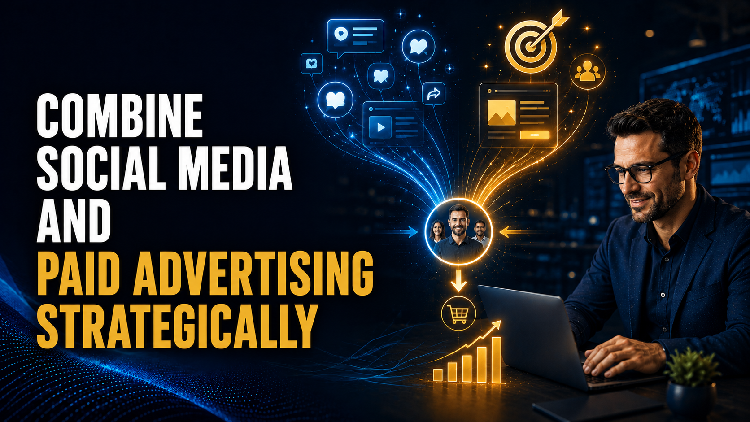
Social media can help you demonstrate personality, expertise, results, and consistency, but activity alone does not guarantee buyers. Choose one or two primary platforms where your audience already consumes relevant information. Develop several repeatable content categories, such as education, customer proof, behind-the-scenes processes, objection handling, product demonstrations, and direct offers. Every post does not need to sell, but your audience should never remain confused about what you offer. Include clear profile links, pinned posts, recognizable branding, and periodic invitations to take the next step. Short-form video remains particularly influential; HubSpot’s current statistics identify short-form video as the content format marketers most frequently associate with strong return on investment.
Paid advertising works best when it accelerates a proven message rather than attempting to rescue an untested offer. Begin with small campaigns targeting a defined audience and a single conversion goal. Search ads can capture existing demand, while social ads can introduce a problem, demonstrate a result, or retarget previous visitors. Send each advertisement to a page that continues the same promise, imagery, and language. If an ad promises a free local-business lead checklist, the landing page should immediately present that checklist—not a general homepage containing ten different choices. Track cost per click, landing-page conversion, qualified-lead cost, sales conversion, customer-acquisition cost, and revenue. Cheap clicks can become extremely expensive when they come from people who will never buy. The objective is not maximum traffic; it is profitable customer acquisition.
Build Trust Before Asking for the Sale
Trust is the invisible currency of every transaction. A buyer may desire your result and afford your price but still hesitate because uncertainty outweighs anticipated value. Is the business legitimate? Will the product work for someone like me? What happens if something goes wrong? Will my information be protected? Can I reach a real person? Your marketing must answer these questions through evidence, transparency, consistency, and professional presentation. Trust signals include clear contact details, an authentic About page, secure checkout, understandable policies, relevant credentials, detailed product information, customer stories, guarantees, demonstrations, and prompt responses.
Consistency matters because buyers frequently move between channels before deciding. They may discover a company through Google, examine its social-media activity, read reviews, visit the website, join the email list, and return days later from a retargeting advertisement. Conflicting prices, outdated business hours, broken links, inconsistent branding, or unanswered complaints create tiny fractures in confidence. Current local-search research indicates that buyers often consult multiple channels, while Google encourages businesses to manage reviews, photos, services, updates, and identifying information through a Business Profile. Conduct a quarterly trust audit by examining every major touchpoint as if you were a skeptical first-time visitor. Do not ask whether the business looks impressive to you. Ask whether it provides enough specific, verifiable information for a cautious stranger to feel safe taking the next step. Google Business Profile
Strengthen Social Proof With Reviews and Results
Social proof reduces perceived risk by showing that other customers have already crossed the bridge and reached the other side. Useful proof includes detailed reviews, video testimonials, before-and-after examples, case studies, customer counts, ratings, professional endorsements, media coverage, and user-generated content. Specificity makes it persuasive. “Excellent service” is pleasant but weak. “The new follow-up system helped us book 18 additional appointments in six weeks” communicates a concrete result. Do not manufacture testimonials or hide relevant conditions. Authentic proof may be less polished, but its credibility gives it power.
Reviews must also be actively managed. BrightLocal’s 2025 survey found that only 42% of consumers trusted reviews as much as personal recommendations, down from 79% in 2020. This does not mean reviews have become unimportant. It suggests that buyers evaluate them more critically and may seek several types of evidence before deciding. Encourage honest reviews shortly after a successful delivery, provide an easy review link, and respond professionally to both praise and criticism. Avoid defensive arguments when addressing negative feedback. A calm response explaining the situation and offering a remedy can sometimes create more confidence than a profile containing only suspiciously perfect praise. Place relevant testimonials close to important decisions, such as pricing sections, booking forms, checkout pages, and calls to action. Social proof works best when it supports a particular claim at the exact moment doubt is likely to appear. BrightLocal Local Consumer Review Survey 2025
Turn More Website Visitors Into Customers
Conversion improvement begins by reducing confusion, effort, anxiety, and distraction. Every important page should have one primary purpose and a visually obvious next action. A visitor should understand what you offer, who it serves, why it matters, and what to do next without deciphering clever language or navigating through a maze. Remove unnecessary menu options and competing calls to action from campaign landing pages. Use readable fonts, mobile-friendly layouts, fast-loading images, meaningful headings, and buttons that accurately describe the next step. Google’s current guidance on visibility in AI search also stresses the importance of a positive page experience, including usable mobile presentation, easy navigation, distinguishable main content, and satisfactory performance. Google guidance for succeeding in AI search
Address objections where they occur. If price is a concern, explain the value, deliverables, payment choices, or potential cost of leaving the problem unresolved. If implementation feels intimidating, show the process and support available. If buyers question suitability, list who the offer is and is not for. Add frequently asked questions, real customer proof, contact options, and a guarantee where appropriate. Test one meaningful element at a time so you know what influenced the result. You could compare two headlines, simplify a form, rewrite the call to action, alter the offer presentation, or remove a checkout step. Conversion optimization is not decoration. It is disciplined work that aligns the page with the buyer’s needs while eliminating obstacles between intention and action.
Improve Your Landing Pages and Calls to Action

A productive landing page guides the visitor through a logical conversation. Begin with a result-oriented headline and a supporting statement explaining the mechanism or audience. Describe the buyer’s current problem in language that feels familiar, then present the offer as a credible route toward the desired result. Explain the main benefits, deliverables, process, proof, price, risk reduction, and next step. The order matters because asking for commitment before establishing relevance and trust feels premature. Think of the page as a salesperson who cannot hear the prospect’s questions. It must anticipate those questions and answer them before uncertainty causes the visitor to leave.
Calls to action should be specific, visible, and appropriate to the level of commitment. A high-priced consulting service might use “Schedule a Strategy Call,” while a low-cost digital guide might use “Get Instant Access.” Repeat the primary call to action after major decision sections, particularly on longer pages, but do not surround it with several unrelated choices. Forms should request only the information necessary for the immediate step. If you need more details later, collect them progressively. On checkout pages, disclose fees, delivery expectations, payment options, and refund terms before the final click. Unexpected costs and unclear conditions create friction precisely when purchasing intent is strongest. Test your own process on a phone using a new browser session. Familiarity can make business owners blind to obstacles that are painfully obvious to first-time buyers.
Follow Up With Prospects Who Are Not Ready
Most prospects will not buy during their first interaction, particularly when the decision involves meaningful cost, risk, or change. Without follow-up, your business pays to attract attention and then discards much of it. Build a permission-based email sequence that helps prospects evaluate the problem, avoid common mistakes, understand available solutions, see evidence, and choose an appropriate next step. A useful welcome sequence might deliver the promised resource, share a quick win, explain a costly misconception, present a customer story, answer objections, and introduce the paid offer. Each message should stand on its own while advancing a coherent conversation.
Segment follow-up according to behavior and interest whenever possible. A person who downloaded a local SEO checklist should not receive the same sequence as someone who viewed an ecommerce checkout service. Use first-party data responsibly and make preferences easy to manage. Content Marketing Institute’s 2026 research found that 91% of surveyed B2B marketers collect first-party data, yet half described their strategies as exploratory or developing. The research also reported benefits including better targeting and personalization for 52% of respondents and increased conversions or return on investment for 26%. Automation can deliver messages at the right time, but it should not make communication feel robotic. Invite replies, monitor questions, remove disengaged contacts when appropriate, and ensure every sequence provides genuine value rather than an exhausting stream of promotions. Content Marketing Institute 2026 research
Generate More Revenue From Existing Customers
The fastest path to another sale often leads through someone who already knows and trusts your business. Existing customers can purchase complementary products, renew subscriptions, upgrade services, refer friends, provide testimonials, and reveal unmet needs. Yet many companies focus almost exclusively on customer acquisition and become strangely silent immediately after payment. That silence wastes goodwill and makes each sale more expensive than necessary. Design a post-purchase journey that confirms the decision, helps the customer obtain value quickly, and introduces relevant future options without applying constant pressure.
Begin with an excellent onboarding experience. Explain what happens next, how to access the purchase, where to obtain help, and what the customer should do first. Check in at meaningful milestones, ask for feedback, and solve small problems before they become cancellations or complaints. Create a logical value ladder in which each additional offer serves the customer’s next problem. Someone purchasing an affiliate-marketing checklist might later need a beginner course, campaign templates, software recommendations, or one-to-one guidance. A local-business client buying a website may later need SEO, email follow-up, reputation management, or conversion optimization. Request referrals only after delivering a result and make the referral process simple. Customer retention is not merely a support function; it is a growth strategy. When customers succeed, their repeat purchases, reviews, examples, and recommendations can lower the cost of attracting every future buyer.
Follow a Practical 30-Day Buyer-Generation Plan
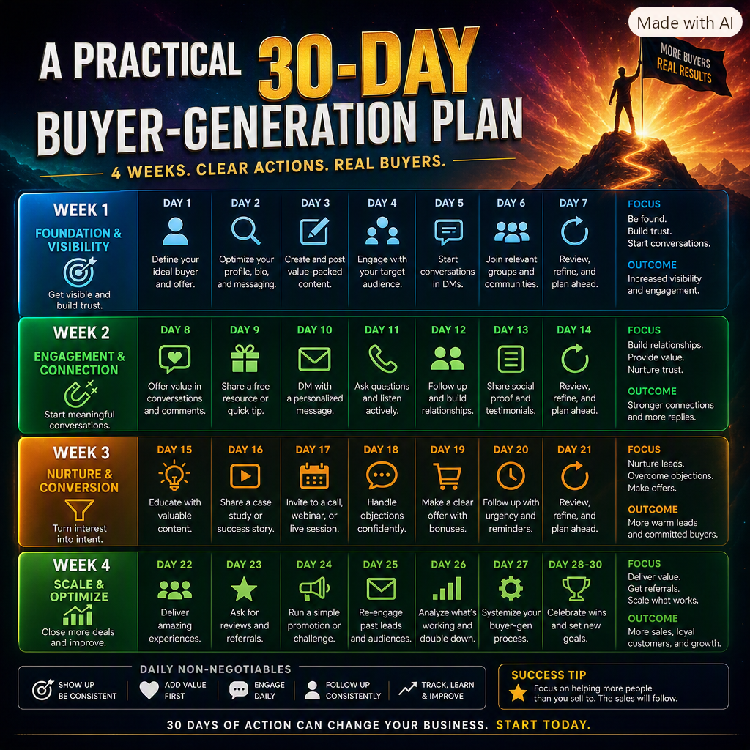
During the first week, diagnose the funnel. Record baseline numbers for relevant traffic, inquiries, sales, conversion rate, acquisition cost, average order value, and repeat purchases. Interview several customers, read recent reviews and support questions, identify your three strongest acquisition sources, and walk through the entire buying experience on desktop and mobile. Rewrite the main value proposition so it identifies the buyer, problem, outcome, and differentiator. By the end of the week, you should know whether the most urgent issue involves traffic, targeting, trust, conversion, or follow-up.
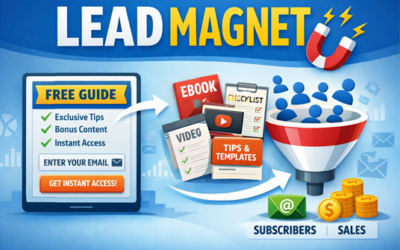
During week two, improve the offer and primary sales page. Strengthen the headline, benefits, evidence, calls to action, frequently asked questions, and risk-reduction elements. Remove distractions and unnecessary form fields. During week three, create or improve one high-intent search page, one comparison or case-study resource, and one lead magnet connected to an automated follow-up sequence. Optimize your Google Business Profile if you serve a local market. During week four, distribute the content through the channels your audience actually uses, contact relevant partners, request reviews from satisfied customers, and run a controlled advertising or retargeting test if the offer already converts organically. Review performance weekly and change only a few major variables at a time. Thirty days may not create a mature marketing engine, but it can replace random promotion with a measurable system and produce valuable evidence about what deserves further investment.
Measure the Numbers That Lead to Revenue
Marketing becomes easier to improve when you stop treating every metric as equally important. Followers, impressions, video views, and page visits can indicate reach, but they do not automatically represent business growth. Focus first on qualified traffic, lead conversion, sales conversion, customer-acquisition cost, average order value, customer lifetime value, gross profit, repeat-purchase rate, and return on marketing investment. HubSpot’s current research shows that marketers place particular importance on lead quality, lead-to-customer conversion, return on investment, acquisition cost, and lead volume. These measurements connect marketing activity to commercial outcomes and help prevent enthusiasm over campaigns that look busy but lose money.
Build a simple weekly dashboard and compare performance by channel, offer, campaign, and customer type. Calculate customer-acquisition cost by dividing acquisition spending by the number of new customers generated. Compare that figure with the gross profit and expected lifetime value of those customers, not merely first-order revenue. Track the percentage of leads that sales considers qualified, because an advertisement producing 200 unsuitable inquiries may be less valuable than a referral partnership producing 20 strong prospects. Add qualitative information as well: common objections, reasons for lost sales, customer questions, and feedback from support conversations. Numbers tell you where the buying journey is weakening; conversations often tell you why. Use both, formulate a hypothesis, test a focused change, and retain what measurably improves results.
Conclusion
If you need more buyers, resist the temptation to chase every new platform, publish random content, or immediately increase advertising. Begin by diagnosing the constraint. Determine whether you need more qualified visibility or better conversion from the attention you already receive. Define a specific audience, align your message with buyer intent, construct an offer around a meaningful outcome, and provide enough proof to reduce uncertainty. Make the purchasing process simple, follow up with prospects who need time, and continue serving customers after the first transaction.
A dependable buyer-generation system resembles a flywheel rather than a fireworks display. Fireworks create a bright moment and then disappear; a flywheel becomes more powerful as connected actions reinforce one another. Helpful content improves visibility. Better visibility produces qualified visitors. Strong offers and proof convert more of those visitors. Successful customers create reviews, referrals, and repeat purchases, which make future acquisition easier. Measure each stage, repair the weakest point, and improve the system one meaningful test at a time. More buyers rarely come from one magical tactic. They come from making your business easier to find, easier to trust, easier to choose, and easier to recommend.
FAQ 1: What is the fastest way to attract more buyers?
The fastest sustainable method is usually to improve conversion among people already discovering your business. Review your main offer, headline, proof, landing page, checkout, and follow-up process before paying for more traffic. If qualified visitors already reach the site, even a modest conversion improvement can generate additional revenue without proportionally increasing acquisition costs. Businesses with almost no relevant traffic should instead start with high-intent search visibility, referrals, partnerships, and carefully targeted advertising. The correct answer depends on the bottleneck, which is why measurement must come before expansion.
FAQ 2: How can a small business compete with larger companies?
Small businesses can compete through specialization, speed, personality, local relevance, and better customer experiences. A large competitor may serve a broad market, while a smaller company can design its message and offer around a narrowly defined customer. Publish detailed content drawn from direct experience, respond quickly, display genuine customer results, and make the buying process personal. Local businesses should maintain accurate information, gather authentic reviews, and optimize their Google Business Profile. Buyers do not always choose the largest provider; they often choose the one that understands their specific situation and makes the decision feel safest.
FAQ 3: How much should I spend on advertising to acquire buyers?
Set the budget according to unit economics rather than selecting an arbitrary amount. Estimate the gross profit from an average customer, repeat-purchase potential, allowable acquisition cost, and cash-flow limitations. Begin with a controlled test large enough to generate meaningful data but small enough that failure will not harm the business. Track qualified leads and completed sales—not just clicks—and pause campaigns that cannot demonstrate a credible route to profitability. Advertising should amplify a validated offer. If your landing page and follow-up process have not produced sales through any source, improve them before committing substantial money.
FAQ 4: How long does it take for SEO to bring customers?
SEO timelines vary according to competition, website authority, technical condition, geographic market, content quality, and keyword difficulty. Local optimization and specific low-competition searches may produce movement sooner than broad national terms, but SEO generally requires consistent effort rather than instant results. Build useful pages around buyer intent, strengthen internal links, improve technical performance, maintain accurate local information, and earn legitimate mentions or links. Combine SEO with email, partnerships, social distribution, and paid campaigns while organic visibility develops. The purpose is to create an asset that continues attracting relevant prospects instead of depending entirely on rented advertising exposure.
FAQ 5: Should I focus on getting new buyers or retaining current customers?
A healthy business needs both, but existing customers frequently offer the more efficient short-term revenue opportunity. They already understand the company, making relevant upgrades, renewals, complementary products, and referrals easier to introduce. Improve onboarding, customer support, follow-up, and next-step offers while continuing to acquire new customers. Measure repeat-purchase rate and customer lifetime value alongside acquisition numbers. Strong retention also improves acquisition because satisfied customers generate reviews, testimonials, case studies, and recommendations. In practical terms, retention and acquisition are not separate engines; excellent customer experiences provide fuel for both.








0 Comments